
Build the Future of Engineering with a Mechanical CADD Certification Course in India
Introduction: Turn Your Mechanical Engineering Skills into Industry-Ready Expertise
The mechanical engineering industry is changing rapidly. Companies now need professionals who can design accurately, develop innovative products, and solve complex engineering challenges using advanced digital tools. Therefore, learning computer-aided design and engineering software has become essential for students and working professionals. A Mechanical CADD training Certification Course in India helps learners develop practical skills in 2D drafting, 3D modelling, product design, simulation, and engineering analysis. More importantly, it connects classroom learning with real-world industry requirements. With the right training, learners can improve their technical confidence, build a strong portfolio, and prepare for exciting career opportunities in design, manufacturing, automotive, aerospace, construction, and other engineering sectors.
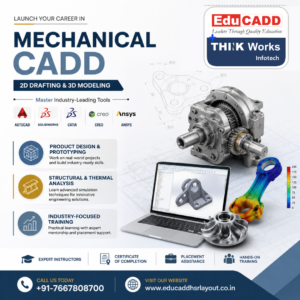
Mechanical CADD Training
Master the Digital Language of Modern Mechanical Engineering
Mechanical Computer-Aided Design and Drafting, commonly known as Mechanical CADD, plays a major role in modern engineering. Instead of creating every design manually, engineers use advanced software to develop accurate drawings and detailed 3D models. As a result, the design process becomes faster, more precise, and easier to modify. A Mechanical CADD Certification Course in India introduces learners to the digital tools used by professional engineers. Students learn how to convert ideas into technical drawings, create mechanical components, and develop complete assemblies. Furthermore, they understand how digital design supports manufacturing, testing, and product development.
Learn 2D Drafting with Professional Accuracy
Mechanical CADD Training 2D drafting remains an important foundation for mechanical design. Engineers use technical drawings to communicate dimensions, materials, manufacturing requirements, and assembly details. Therefore, students must understand drafting standards and drawing practices. A quality training program teaches learners how to create professional layouts, sectional views, dimensions, annotations, and detailed engineering drawings. AutoCAD is widely used for this purpose. Through practical exercises, students can learn how to prepare industry-standard drawings with better accuracy. Consequently, they become more confident while working on real engineering documentation and technical design projects.
Develop Advanced 3D Modelling Skills
Mechanical CADD Training Modern industries increasingly depend on 3D modelling for product development. Engineers can visualise components, test assemblies, and identify design problems before manufacturing begins. Therefore, 3D modelling has become a valuable skill for mechanical professionals. A Mechanical CADD Certification Course in India can provide hands-on training in platforms such as SolidWorks, CATIA, Creo, and other industry-relevant software. Students learn part modelling, assembly design, surface modelling, and drawing generation. In addition, they understand how to create complex components from basic sketches. This practical knowledge prepares learners for real-world product design and engineering projects.
Explore Product Design and Prototyping
Great products begin with strong design concepts. However, transforming an idea into a functional product requires technical knowledge and practical planning. CADD training helps students understand the complete product development process. They can create concepts, develop digital models, modify designs, and prepare them for prototyping. A Mechanical CADD Certification Course in India also introduces learners to design thinking and engineering problem-solving. Through real-world projects, students gain valuable experience in developing practical solutions. As a result, they can create stronger portfolios that demonstrate both software skills and creative engineering ability.
Understand Engineering Analysis and Simulation
Mechanical CADD Training Designing a component is only one part of mechanical engineering. Engineers must also understand how a product behaves under different conditions. Simulation tools help professionals study stress, deformation, temperature, vibration, and other performance factors. Therefore, analysis knowledge can significantly improve a learner’s technical profile. Advanced CADD programs introduce students to tools such as ANSYS and related simulation platforms. Learners can study structural and thermal behaviour through practical exercises. Moreover, they understand how simulation supports better design decisions. This knowledge is especially valuable in industries that require safe, reliable, and high-performance products.
Gain Industry-Relevant Knowledge Through Practical Training
Software knowledge alone may not be enough to build a successful career. Employers also value practical understanding and problem-solving skills. Therefore, project-based learning plays an important role in professional training. A strong Mechanical CADD Certification Course in India includes practical assignments based on real engineering requirements. Students may work on machine components, product assemblies, industrial models, and analysis projects. They learn how to manage design challenges and correct technical mistakes. Additionally, project work helps learners understand the complete workflow followed in professional engineering environments.
Learn Multiple Software Platforms for Greater Career Flexibility
Different industries use different design and engineering software. For example, automotive companies may use CATIA or Creo, while many product design teams use SolidWorks. Similarly, engineering companies may use AutoCAD and ANSYS for specific applications. Therefore, learning multiple platforms can provide greater career flexibility. A comprehensive training program allows students to understand the features and applications of different tools. As a result, learners can adapt more easily to different job requirements. This broader skill set can also help candidates stand out during interviews and technical evaluations.
Improve Your Career Opportunities Across Industries
Mechanical CADD skills are useful across several industries. Automotive companies require professionals for vehicle and component design. Manufacturing organisations need experts for production drawings and mechanical modelling. Aerospace companies depend on highly accurate design and analysis. Similarly, consumer product companies require professionals who can develop innovative products. A Mechanical CADD Certification Course in India can help learners prepare for opportunities in these diverse sectors. Furthermore, the skills gained through CADD training can support careers in design engineering, CAD engineering, product development, drafting, modelling, and simulation.
Build a Strong Professional Portfolio
A professional portfolio can make a significant difference during job applications. Instead of simply listing software names on a resume, candidates can showcase completed projects and technical achievements. Therefore, students should focus on developing a portfolio during their training. A good CADD course encourages learners to create practical designs, assemblies, technical drawings, and simulation projects. These examples demonstrate actual capability to potential employers. In addition, a strong portfolio helps candidates explain their design approach during interviews. Consequently, students can present themselves with greater confidence and professionalism.
Learn from Experienced Industry Professionals
The quality of training depends greatly on the guidance students receive. Experienced trainers can explain not only how software works but also how engineers use it in real projects. Therefore, learners should select a training centre that focuses on practical and industry-oriented education. Trainers with professional experience can provide valuable insights into design standards, common mistakes, project workflows, and workplace expectations. A Mechanical CADD Certification Course in India becomes more valuable when students receive regular feedback and guidance. This approach helps learners improve their technical skills while developing professional discipline.
Prepare for the Demands of a Competitive Job Market
The engineering job market is becoming increasingly competitive. Employers often look for candidates who can contribute to projects from the beginning. Therefore, additional technical certification can provide an advantage to students and professionals. CADD training helps learners develop practical software knowledge that complements their academic qualifications. Furthermore, certification demonstrates a commitment to professional development. However, learners should remember that a certificate alone does not guarantee success. Practical skills, project experience, communication ability, and continuous learning are equally important for long-term career growth.
Choose a Course That Matches Your Career Goals
Every learner has different career objectives. Some students may want to become design engineers, while others may prefer product development, manufacturing, or analysis. Therefore, choosing the right training path is important. Before enrolling, learners should understand the software included, project exposure, trainer experience, course duration, and career support. A well-planned Mechanical CADD Certification Course in India should match the learner’s interests and professional goals. Additionally, students should consider whether the program offers hands-on practice instead of focusing only on theoretical lessons.
Start Building Your Engineering Career Today
The right time to develop technical skills is before the industry demands them. Mechanical CADD training provides a practical pathway for students, graduates, and working professionals who want to strengthen their engineering careers. By learning 2D drafting, 3D modelling, product design, prototyping, and simulation, learners can build a versatile technical foundation. Furthermore, real-world projects help connect software knowledge with professional applications. With consistent practice and the right guidance, students can move closer to their career goals and become more prepared for modern engineering opportunities.
Why Professional Training Can Make a Difference
Self-learning can provide basic software knowledge. However, structured professional training offers a more complete learning experience. Students receive a planned curriculum, practical assignments, trainer support, and opportunities to correct their mistakes. A Mechanical CADD Certification Course in India can also help learners follow a systematic path from basic drafting to advanced engineering applications. As a result, they can avoid confusion and develop their skills step by step. Most importantly, professional training encourages learners to practise regularly and understand how different design tools work together in real engineering projects.
Conclusion: Design Your Skills Today for the Engineering Opportunities of Tomorrow
Mechanical engineering is moving towards a more digital, innovative, and technology-driven future. As industries continue to adopt advanced design and simulation tools, skilled CADD professionals will remain in demand. A Mechanical CADD Certification Course in India can help learners develop the practical knowledge required to work with modern engineering software and real-world design challenges. From 2D drafting and 3D modelling to product design, prototyping, and advanced analysis, the right training can create a strong foundation for career growth. Therefore, students and professionals who want to build a successful future in mechanical design should invest in practical learning, develop a strong project portfolio, and continue improving their technical skills. With dedication, the right guidance, and industry-focused training, your engineering ideas can become innovative designs, functional products, and rewarding career opportunities.

